What Is Bromelain and How Is It Used in Meat Tenderization?
B2B guide to bromelain enzyme for meat tenderization: dosage, pH, temperature, QC, pilot validation, COA/TDS/SDS, and cost-in-use.
Bromelain is a pineapple-derived proteolytic enzyme used by meat processors to improve tenderness, bite consistency, and processing yield when dosage, contact time, pH, and heat control are validated at plant scale.
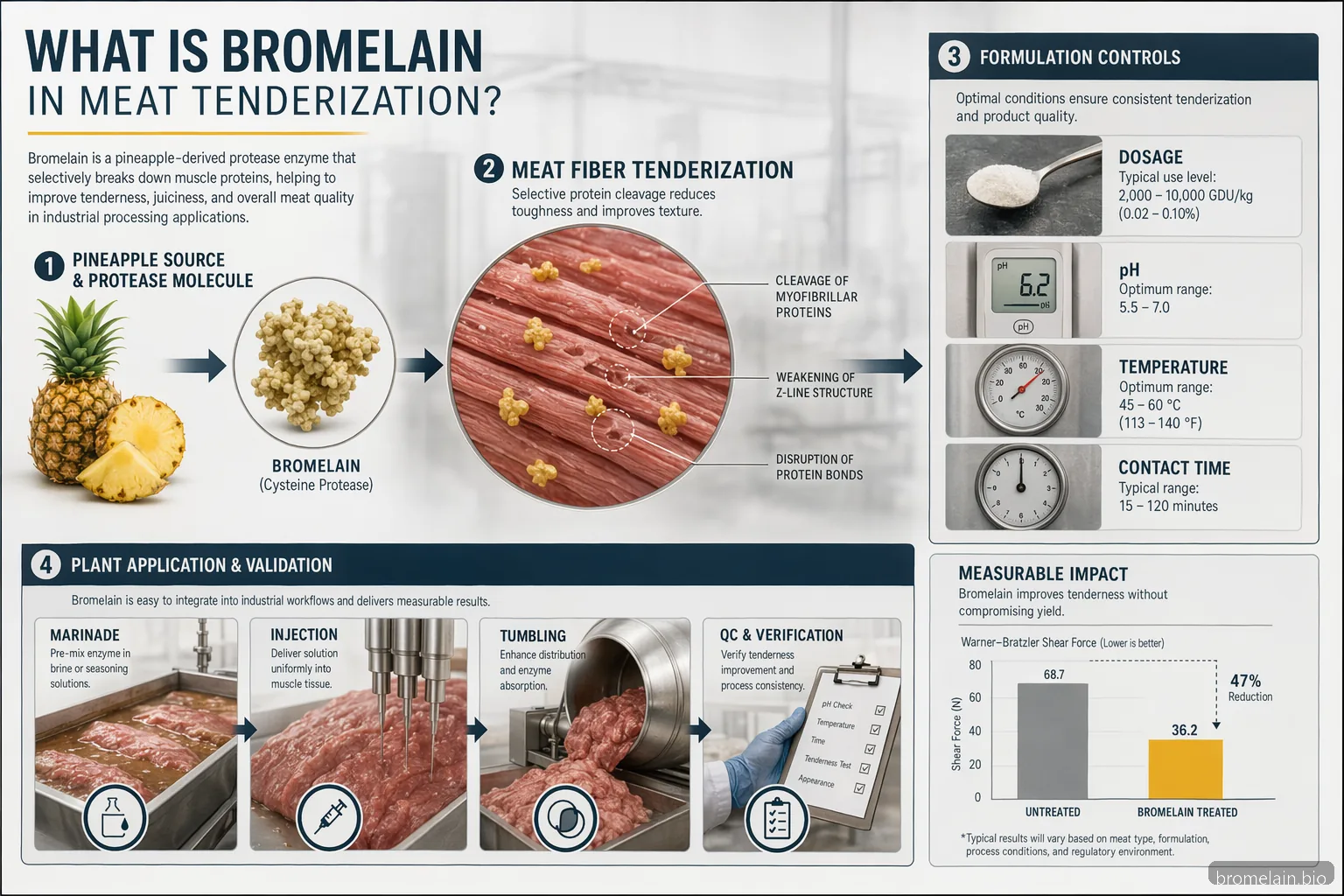
What Is Bromelain in Industrial Meat Processing?
Bromelain is a group of proteolytic enzymes commonly extracted from pineapple stem or fruit. In meat tenderization, its value comes from controlled hydrolysis of muscle proteins and connective-tissue-associated proteins, which can soften texture and improve bite uniformity. For B2B formulators, the question is not simply “what is bromelain” but how the bromelain enzyme behaves in a specific meat system, brine, marinade, injection process, or tumble cycle. Activity depends on enzyme grade, assay method, pH, salt level, temperature, contact time, and heat inactivation. Search terms such as bromelain nedir, bromelain wirkung, wirkung von bromelain, and pineapple bromelain often describe general interest, but industrial use requires documented functionality and validated process windows. Buyers should compare suppliers by activity units, carrier system, solubility, regulatory suitability for the target market, and technical support rather than by generic product names.
Primary function: controlled proteolysis for texture modification. • Common forms: powder, granule, or formulated blend. • Key control point: avoid over-tenderization or mushy texture.
Formulation Targets: Dosage, pH, Temperature, and Contact Time
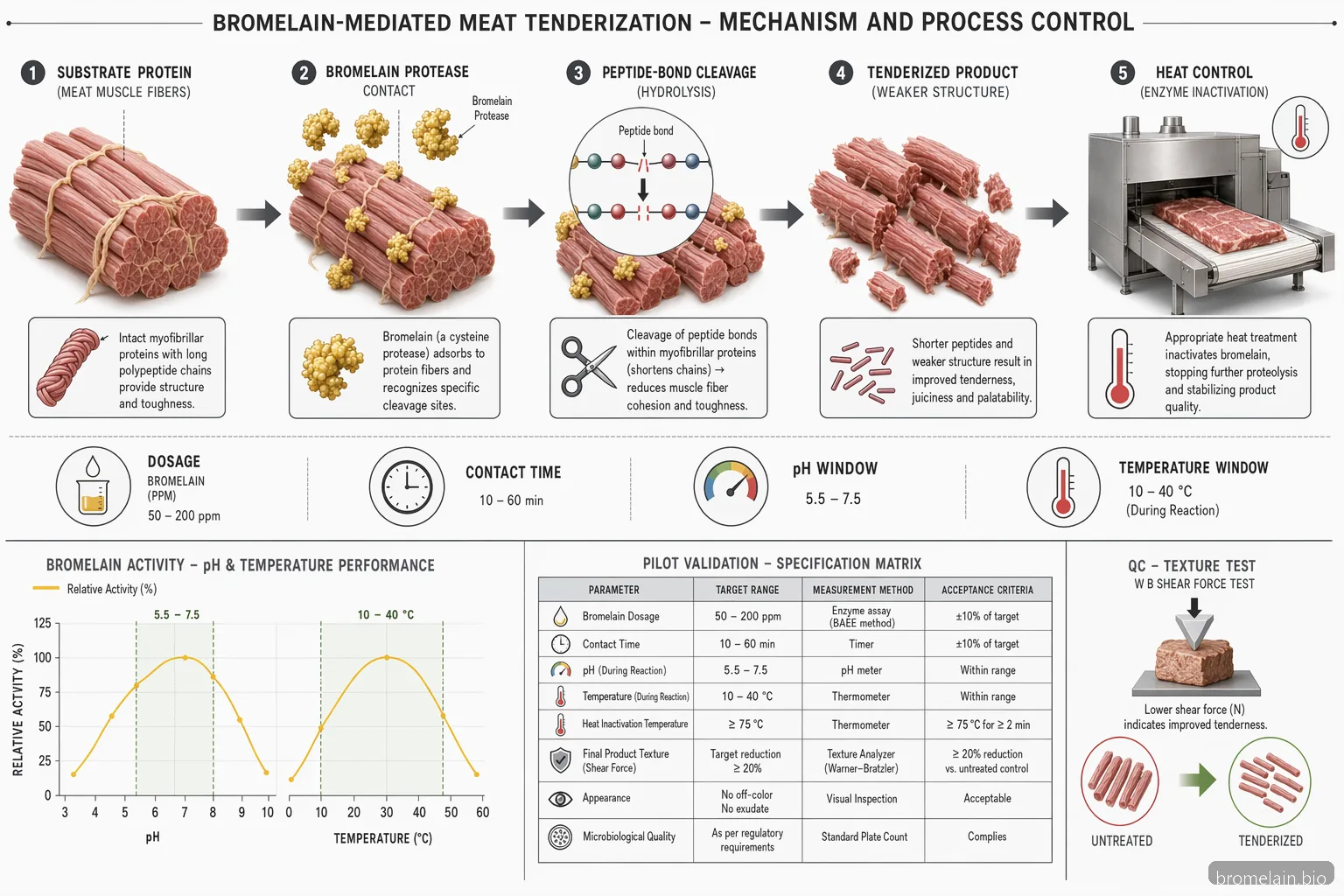
A practical starting range for meat tenderization trials is often 20-200 ppm active enzyme preparation on meat weight, adjusted according to declared activity, substrate, cut size, and desired tenderness. Lower dosages suit thin cuts, injected products, or long contact times; higher dosages may be tested for tougher cuts only under close sensory and texture monitoring. Bromelain typically performs well in mildly acidic to neutral systems, so pH 5.5-7.5 is a useful development range for marinades and brines. Processing temperatures are usually kept chilled for food safety, commonly 0-8°C during holding, with enzyme action continuing slowly. Faster tenderization may occur at warmer preparation steps, around 20-50°C, but must be validated against microbial controls and product quality. Heat treatment, such as cooking, generally reduces enzyme activity, helping stop the reaction once the desired texture is reached.
Trial dosage: 20-200 ppm enzyme preparation on meat weight. • Development pH: 5.5-7.5 for many brine or marinade systems. • Chilled hold: 0-8°C where food safety programs require it. • Reaction stop: validated cooking or heat inactivation step.
Where Bromelain Fits in Marinades, Injection, and Tumbling
Bromelain can be incorporated into dry seasoning, liquid marinade, injection brine, or tumble systems, but the sequence of addition matters. For liquid systems, disperse the enzyme uniformly after salts, phosphates, sugars, acids, and hydrocolloids are fully hydrated, unless the supplier TDS recommends a different order. Avoid localized high enzyme concentration, because it can create uneven soft spots. In injection applications, confirm solubility and screen compatibility to reduce nozzle blockage and sediment. In tumbling, monitor vacuum, time, load size, and temperature because mechanical action can increase distribution and accelerate tenderness changes. For dry rubs or surface applications, enzyme penetration is limited, so time, moisture, and cut thickness become major variables. The best formulation is the one that delivers consistent texture at the lowest reliable cost-in-use, not necessarily the highest enzyme activity per kilogram.
Use good dispersion to prevent uneven tenderization. • Check brine clarity, sediment, and injector screen performance. • Validate tumble time and temperature with each meat format. • Calculate cost-in-use per finished kilogram, not only price per kilogram.
QC Checks for Pilot and Production Validation
Pilot validation should use the actual meat species, cut, supplier variability, equipment, brine composition, and thermal process planned for production. Start with a small dosage matrix, such as control, low, medium, and high enzyme levels, then evaluate at defined hold times. Useful QC checks include pH, brine pickup, yield, purge, cook loss, sliceability, texture analyzer readings, sensory bite panels, and visual inspection for surface breakdown. Microbiological checks should follow the processor’s food safety plan, especially if warm holding is considered. Enzyme activity should be verified against the supplier COA and internal acceptance criteria where available. Record contact time from enzyme addition to heat inactivation, not only marination time. A successful pilot creates a repeatable process window with upper and lower limits, corrective actions, and finished-product specifications that production teams can control.
Compare control versus multiple dosage levels. • Measure texture, yield, purge, and cook loss. • Track exact enzyme contact time before cooking. • Confirm microbiological controls for the chosen process.
Supplier Qualification and Documentation for Buyers
Industrial buyers should request a current COA, TDS, SDS, ingredient statement, allergen information, country of origin, storage conditions, shelf-life guidance, and declared activity method before approving a bromelain supplier. The COA should align with the purchase specification, including activity, appearance, moisture where relevant, microbiological limits, and heavy metal limits if required by the buyer’s program. The TDS should provide practical use guidance, solubility notes, pH and temperature information, and recommended handling. The SDS supports safe handling for powder exposure and workplace controls. For global projects, confirm regulatory suitability in each destination market rather than assuming one approval covers all regions. Keywords such as bromelain forte, bromelain supplement, bromelain wirkungseintritt, and bromelain yan etkileri are more common in consumer supplement searches; procurement for meat processing should focus on technical performance, documentation, supply reliability, and batch consistency.
Request COA, TDS, SDS, origin, and allergen documentation. • Confirm activity method and acceptance specification. • Review batch consistency, lead time, packaging, and storage. • Approve only after pilot validation in the actual formulation.
Technical Buying Checklist
Buyer Questions
Bromelain is a pineapple bromelain protease system used to hydrolyze selected meat proteins. In industrial meat tenderization, it is added through marinades, injection brines, tumbling systems, or surface treatments to modify texture. Its performance depends on activity, dosage, pH, temperature, contact time, meat type, and the final heat process used to stop the reaction.
A common pilot starting range is 20-200 ppm of the enzyme preparation on meat weight, but the correct level depends on declared activity, formulation, cut thickness, process time, and target bite. Processors should test a control and several dosage levels, then measure texture, purge, yield, cook loss, and sensory quality before setting a production specification.
For many meat marinades and brines, pH 5.5-7.5 is a practical development range. Chilled processing at 0-8°C is common where food safety controls require it, although enzyme action is slower. Warmer steps can accelerate activity, but they must be validated for microbial safety, product quality, and repeatable inactivation during cooking.
Compare suppliers using declared activity method, batch COA data, TDS application guidance, SDS handling information, origin, allergen statement, packaging, shelf life, lead time, and technical support. The lowest price per kilogram may not be the lowest cost-in-use. Pilot validation should confirm that the selected grade performs consistently in the actual meat formulation.
No. A bromelain supplement is positioned for consumer use, while industrial bromelain for meat processing is selected for functional enzyme activity, documentation, handling, formulation compatibility, and regulatory suitability in food manufacturing. This page addresses B2B formulation and processing, not medical, dosage, or health advice for consumers.
Request a Free Sample and Quote
Tell us about your application and volume. We will send a free sample, COA, and competitive pricing within 24 hours.
Frequently Asked Questions
What is bromelain for meat tenderization?
Bromelain is a pineapple bromelain protease system used to hydrolyze selected meat proteins. In industrial meat tenderization, it is added through marinades, injection brines, tumbling systems, or surface treatments to modify texture. Its performance depends on activity, dosage, pH, temperature, contact time, meat type, and the final heat process used to stop the reaction.
How much bromelain enzyme should a processor use?
A common pilot starting range is 20-200 ppm of the enzyme preparation on meat weight, but the correct level depends on declared activity, formulation, cut thickness, process time, and target bite. Processors should test a control and several dosage levels, then measure texture, purge, yield, cook loss, and sensory quality before setting a production specification.
What pH and temperature are suitable for bromelain formulations?
For many meat marinades and brines, pH 5.5-7.5 is a practical development range. Chilled processing at 0-8°C is common where food safety controls require it, although enzyme action is slower. Warmer steps can accelerate activity, but they must be validated for microbial safety, product quality, and repeatable inactivation during cooking.
How do buyers compare bromelain suppliers?
Compare suppliers using declared activity method, batch COA data, TDS application guidance, SDS handling information, origin, allergen statement, packaging, shelf life, lead time, and technical support. The lowest price per kilogram may not be the lowest cost-in-use. Pilot validation should confirm that the selected grade performs consistently in the actual meat formulation.
Is bromelain the same as a bromelain supplement?
No. A bromelain supplement is positioned for consumer use, while industrial bromelain for meat processing is selected for functional enzyme activity, documentation, handling, formulation compatibility, and regulatory suitability in food manufacturing. This page addresses B2B formulation and processing, not medical, dosage, or health advice for consumers.
Related: Bromelain Enzyme for Meat Tenderization
Turn This Guide Into a Supplier Brief Request a bromelain COA/TDS/SDS review and pilot formulation support for your meat tenderization project. See our application page for Bromelain Enzyme for Meat Tenderization at /applications/bromelain-meat-tenderization/ for specs, MOQ, and a free 50 g sample.
Contact