Bromelain Powder for Industrial Meat Tenderization
Source bromelain powder for controlled meat tenderization with dosage, pH, temperature, QC, COA/TDS/SDS, pilot validation, and cost-in-use guidance.
A practical B2B guide for processors using bromelain enzyme to improve tenderness, standardize bite, and validate cost-in-use across marinades, tumbling, and injection systems.
What Is Bromelain Powder in Meat Processing?
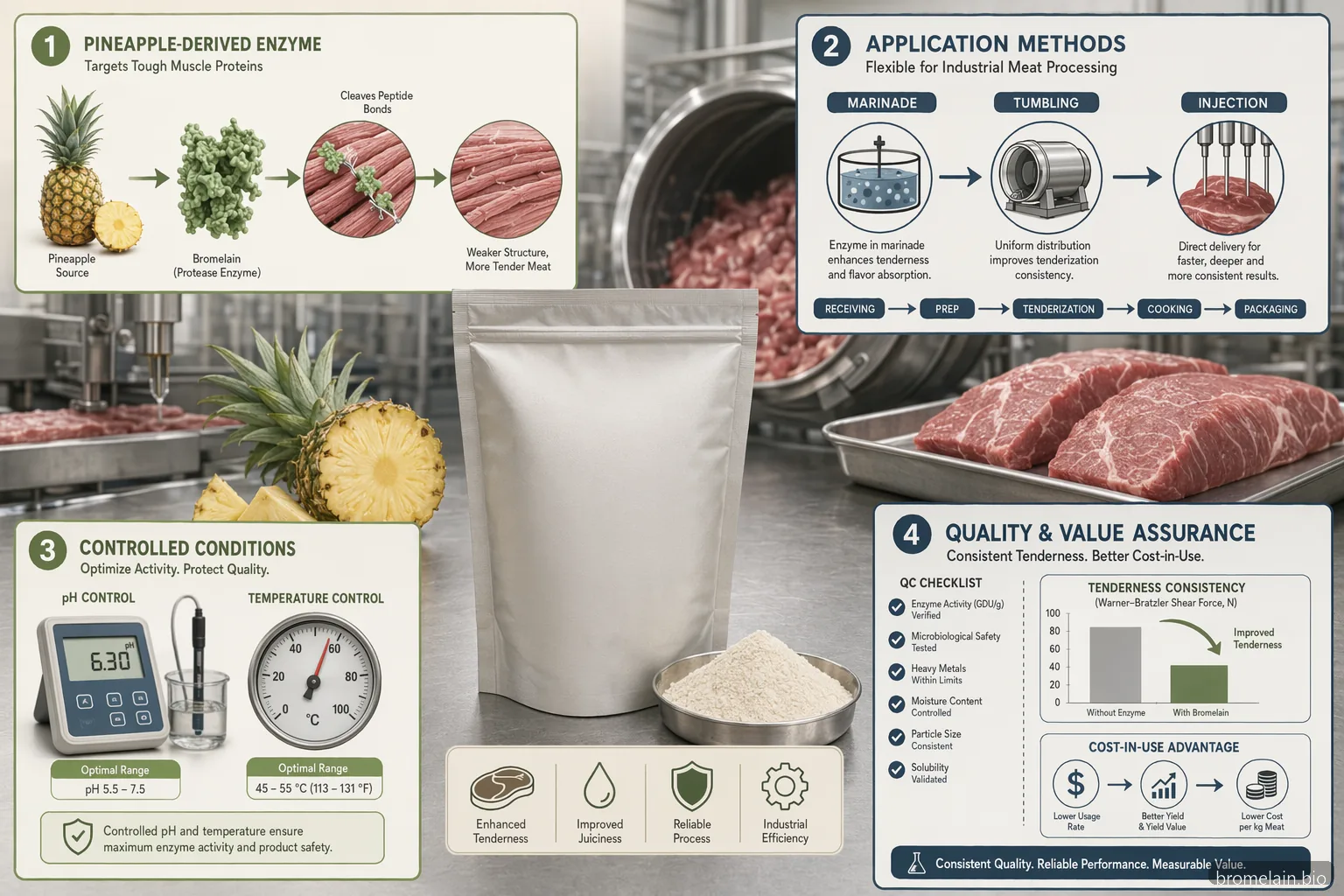
Bromelain powder is a proteolytic enzyme preparation derived from pineapple, often from stem material. In meat applications, bromelain enzyme breaks peptide bonds in proteins such as myofibrillar and connective tissue proteins, helping reduce toughness in beef, pork, poultry, and value-added marinated products. Buyers searching for “what is bromelain” or “bromelain nedir” often find supplement content, but industrial purchasing requires a different lens: enzyme activity, carrier system, solubility, particle handling, regulatory suitability, and repeatable process performance. For meat tenderization, bromelain should be treated as a functional processing aid or ingredient according to local rules and product labeling requirements. It is not selected for medical effects, “bromelain forte” positioning, or consumer supplement claims. The commercial objective is predictable texture improvement without mushiness, excessive purge, flavor defects, or yield loss.
Application focus: meat tenderization, not dietary supplement advice • Source: pineapple-derived protease preparation • Main function: controlled protein hydrolysis • Key purchasing variable: declared enzyme activity, not only price per kilogram
Process Conditions for Controlled Tenderization
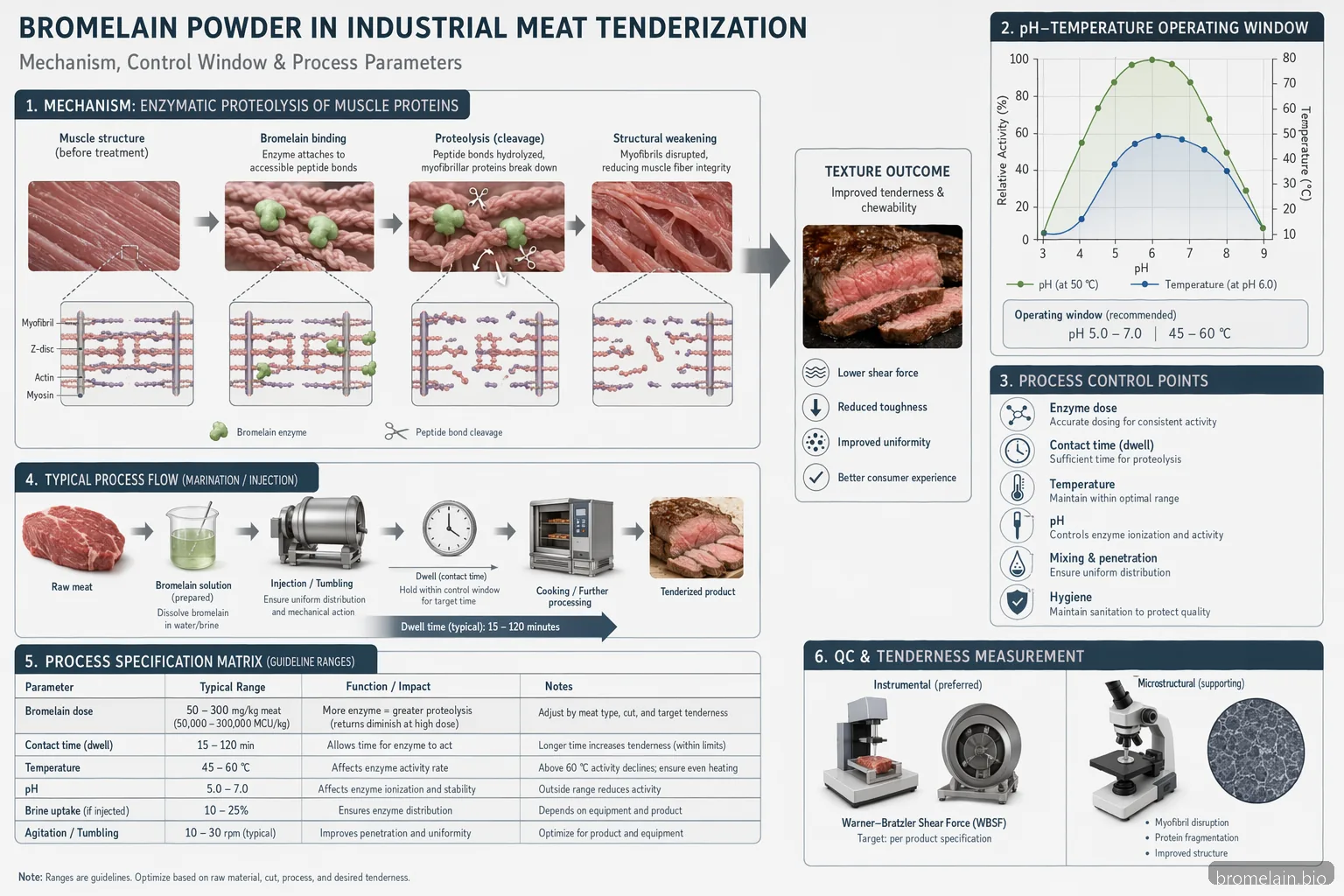
A practical bromelain powder trial starts with the meat format, brine system, and target eating quality. Bromelain generally performs well in mildly acidic to near-neutral systems; a screening pH range of 5.0–7.0 is commonly useful for marinades and injected products, while supplier data should define the validated range. Temperature has a major effect on reaction speed. Chilled processing at 2–10°C can provide slower, safer tenderization during marination or tumbling, while warm steps increase activity and require tight time control. Avoid uncontrolled holding at elevated temperatures because over-tenderization can develop quickly. Common starting use levels are 0.02–0.20% bromelain powder based on meat weight, or a supplier-recommended ppm level based on activity units. Final dosage must be set by pilot validation, not copied from another plant.
Screen pH: typically 5.0–7.0 for many meat systems • Cold marination: 2–10°C for slower enzyme action • Starting dosage: often 0.02–0.20% powder on meat weight • Validate by activity units and product performance
How to Apply Bromelain in Marinades, Tumbling, and Injection
For marinades, disperse bromelain powder into water or brine with sufficient agitation to prevent clumping before adding to meat. In tumbling systems, ensure even distribution and record vacuum level, tumble time, brine pickup, and dwell time after tumbling. For injection, confirm the powder fully dissolves or disperses and does not block needles or filters; pre-filtration may be needed depending on the carrier and insoluble matter. Bromelain should be added at a controlled step so contact time is repeatable from batch to batch. Salt, phosphates, acids, sugars, flavors, and starches may change water activity, pH, and viscosity, so test the complete formula rather than enzyme in water only. If a thermal cook step follows, the process may reduce residual enzyme activity, but inactivation depends on actual time, temperature, matrix, and particle size.
Pre-disperse before contact with meat • Record pickup, dwell time, and temperature • Check injection compatibility and needle blockage risk • Test the full brine formula, not enzyme alone
Quality Control: Measuring Bromelain Wirkung in Food Plants
German searches such as “bromelain wirkung,” “wirkung von bromelain,” and “bromelain wirkungseintritt” refer to effect and onset. In a processing plant, the relevant effect is measurable texture change over time, not a health outcome. Build a QC plan around objective and sensory endpoints. Warner-Bratzler shear force, texture profile analysis, slice integrity, purge loss, cook yield, pH, color, and trained sensory panels are useful checks. Compare treated lots against an untreated control and a current commercial benchmark. Over-processing signs include pasty surface texture, weak bite, excessive exudate, poor slicing, or inconsistent tenderness between pieces. Because enzyme activity varies by supplier and grade, each incoming lot should be tied to a COA and verified against plant performance data when risk justifies it.
Use untreated and benchmark controls • Track shear force or texture profile results • Monitor purge, cook yield, and sliceability • Link incoming lots to COA and batch records
Supplier Qualification and Documentation
Industrial bromelain buyers should qualify suppliers with documentation and sample-to-scale support. Request a current Certificate of Analysis (COA) showing activity units, test method, microbiological limits, moisture, appearance, and lot identification. The Technical Data Sheet (TDS) should describe composition, activity range, solubility, recommended pH and temperature conditions, storage, shelf life, and application guidance. The Safety Data Sheet (SDS) should address safe handling because enzyme powders may cause respiratory or skin sensitization if mishandled. Also ask for allergen statements, country of origin, manufacturing flow information where available, GMO status if relevant to your market, and food-grade suitability statements supported by applicable regulations. Avoid supplier selection based only on “bromelain powder” price; inconsistent activity can increase rework, claims, and yield loss.
Request COA, TDS, SDS, and allergen statement • Confirm activity method and unit definition • Assess lot consistency and technical support • Review storage, shelf life, and handling controls
Pilot Validation and Cost-in-Use
Cost-in-use is the correct way to evaluate bromelain powder for meat tenderization. A lower price per kilogram may be less economical if activity is low, dispersion is poor, or the process requires longer dwell time. Run a pilot design with at least three dosage levels, a no-enzyme control, and the intended plant conditions. Measure raw pickup, purge, cook yield, texture, sensory quality, throughput effect, and reject rate. Include hold-time abuse testing within safe food handling limits to understand over-tenderization risk. Scale-up should confirm that mixing energy, brine temperature, equipment residence time, and packaging schedule match the validated window. For private label or export products, regulatory and labeling checks should be completed before commercial launch. A qualified supplier should help interpret results without making unverifiable performance claims.
Compare cost per finished kilogram, not only enzyme price • Pilot at three dosage levels plus a control • Measure yield, texture, sensory, and rework risk • Confirm labeling and market requirements before launch
Technical Buying Checklist
Buyer Questions
Bromelain powder can be suitable for marinades, tumbling, injection, and some formed meat systems, but it is not universal. Performance depends on meat species, cut size, pH, salt level, contact time, temperature, and the enzyme grade. Processors should run pilot trials under real plant conditions and compare texture, yield, purge, and sensory results before approving routine production.
The practical “bromelain wirkungseintritt” in meat processing depends on dosage, activity, temperature, pH, and distribution. Thin cuts or injected products may show texture changes faster than large whole-muscle pieces. Chilled conditions slow the reaction, which can improve control. Rather than relying on a fixed time, validate a processing window with texture testing and hold-time challenge trials.
For B2B meat processing, “bromelain yan etkileri” is best interpreted as process risks, not medical side effects. Main risks include over-tenderized texture, mushy surfaces, excessive purge, yield loss, inconsistent bite, and occupational sensitization from enzyme dust. Manage these risks with controlled dosage, temperature, dwell time, dust control, PPE, and incoming lot documentation from the supplier.
A qualified supplier should provide a COA for each lot, a TDS, and an SDS. The COA should state activity units, method, microbiological limits, moisture, appearance, and lot number. The TDS should cover composition, recommended processing conditions, storage, and shelf life. Buyers may also need allergen, origin, GMO status, and food-grade suitability statements for their market.
Compare suppliers by cost-in-use, not just price per kilogram. Review activity level, unit definition, lot consistency, solubility, handling, microbiological quality, documentation quality, lead time, and technical support. Run side-by-side pilots at equivalent activity, then measure tenderness, yield, purge, cook performance, and sensory acceptance. A supplier with reliable activity can reduce rework and improve process control.
Request a Free Sample and Quote
Tell us about your application and volume. We will send a free sample, COA, and competitive pricing within 24 hours.
Frequently Asked Questions
Is bromelain powder suitable for all meat tenderization systems?
Bromelain powder can be suitable for marinades, tumbling, injection, and some formed meat systems, but it is not universal. Performance depends on meat species, cut size, pH, salt level, contact time, temperature, and the enzyme grade. Processors should run pilot trials under real plant conditions and compare texture, yield, purge, and sensory results before approving routine production.
How fast does bromelain work in meat?
The practical “bromelain wirkungseintritt” in meat processing depends on dosage, activity, temperature, pH, and distribution. Thin cuts or injected products may show texture changes faster than large whole-muscle pieces. Chilled conditions slow the reaction, which can improve control. Rather than relying on a fixed time, validate a processing window with texture testing and hold-time challenge trials.
What are the side effects of bromelain in food manufacturing?
For B2B meat processing, “bromelain yan etkileri” is best interpreted as process risks, not medical side effects. Main risks include over-tenderized texture, mushy surfaces, excessive purge, yield loss, inconsistent bite, and occupational sensitization from enzyme dust. Manage these risks with controlled dosage, temperature, dwell time, dust control, PPE, and incoming lot documentation from the supplier.
What documents should a bromelain supplier provide?
A qualified supplier should provide a COA for each lot, a TDS, and an SDS. The COA should state activity units, method, microbiological limits, moisture, appearance, and lot number. The TDS should cover composition, recommended processing conditions, storage, and shelf life. Buyers may also need allergen, origin, GMO status, and food-grade suitability statements for their market.
How should we compare bromelain powder suppliers?
Compare suppliers by cost-in-use, not just price per kilogram. Review activity level, unit definition, lot consistency, solubility, handling, microbiological quality, documentation quality, lead time, and technical support. Run side-by-side pilots at equivalent activity, then measure tenderness, yield, purge, cook performance, and sensory acceptance. A supplier with reliable activity can reduce rework and improve process control.
Related: Bromelain Enzyme for Meat Tenderization
Turn This Guide Into a Supplier Brief Request a bromelain powder sample, COA/TDS/SDS package, and pilot dosage guidance for your meat tenderization process. See our application page for Bromelain Enzyme for Meat Tenderization at /applications/bromelain-meat-tenderization/ for specs, MOQ, and a free 50 g sample.
Contact