Bromelain Supplier Guide for Industrial Meat Tenderization
Source bromelain for meat tenderization with practical pH, temperature, dosage, QC, COA/TDS/SDS, pilot validation, and cost-in-use guidance.
A practical B2B guide for processors sourcing bromelain enzyme to improve tenderness, standardize texture, and validate cost-in-use in meat applications.
Why Bromelain Is Used in Meat Tenderization
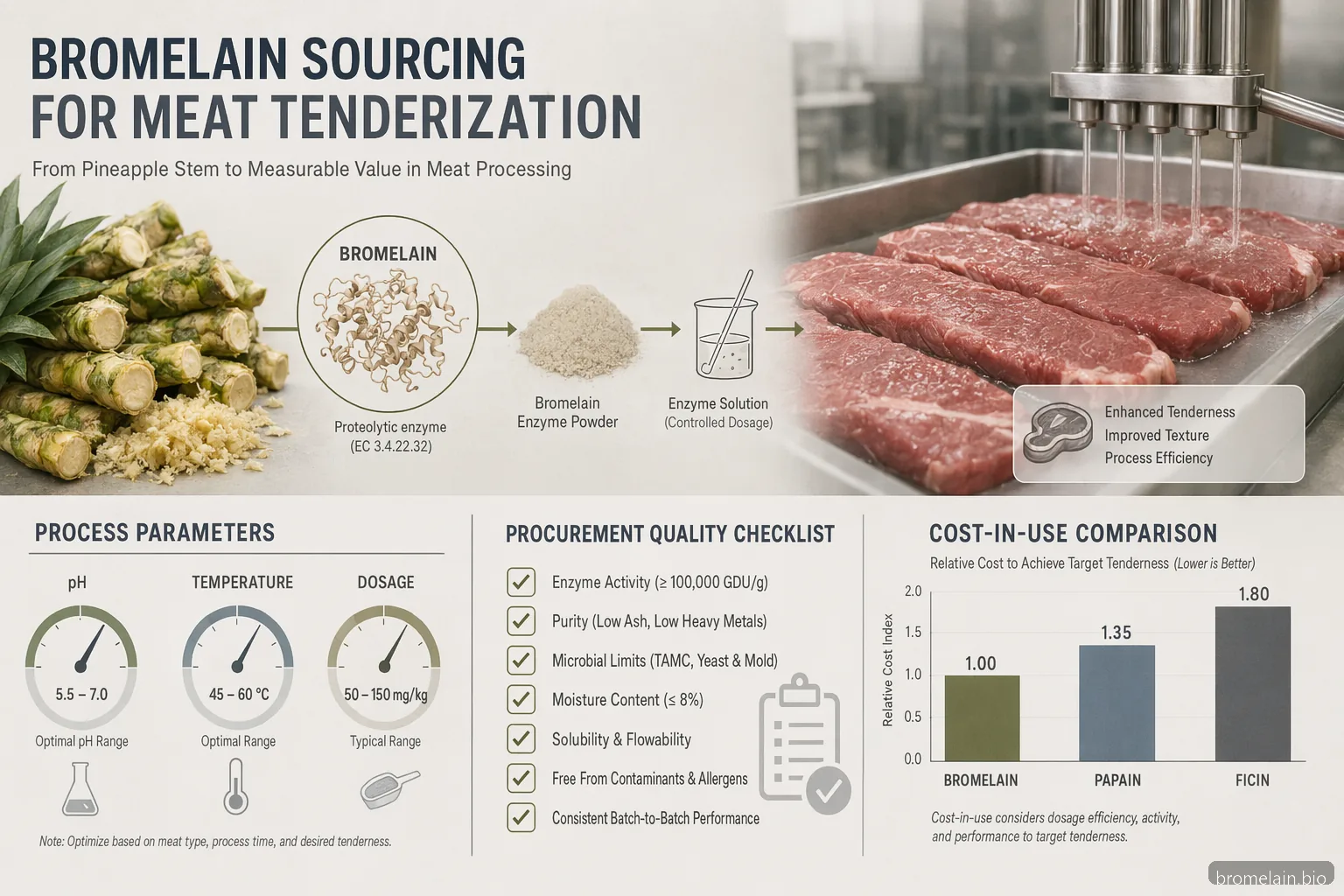
Bromelain is a proteolytic enzyme complex commonly sourced from pineapple stem or fruit material. In meat processing, the bromelain enzyme cleaves peptide bonds in muscle proteins and connective tissue, helping processors improve tenderness, bite, and eating quality. For B2B buyers, the goal is not simply to add a pineapple enzyme, but to achieve repeatable texture within a defined process window. Bromelain is used in injected products, tumbling marinades, topical applications, restructured meats, and certain ready-to-cook formats. Performance depends on substrate, meat cut, particle size, salt level, pH, temperature, contact time, and downstream thermal processing. Compared with uncontrolled tenderization methods, enzyme-based processing can be validated through pilot trials and quality checks. The key purchasing question is whether the supplier can provide a consistent activity grade, documentation, and technical guidance that aligns with the processor’s formulation, equipment, labeling, and food safety requirements.
Common use: beef, poultry, pork, seafood, and restructured meat systems • Primary function: controlled proteolysis for improved tenderness • Critical risk: excessive softening if dosage or contact time is not controlled • Best fit: plants that can validate process conditions and inactivation steps
Process Conditions: pH, Temperature, Dosage, and Time
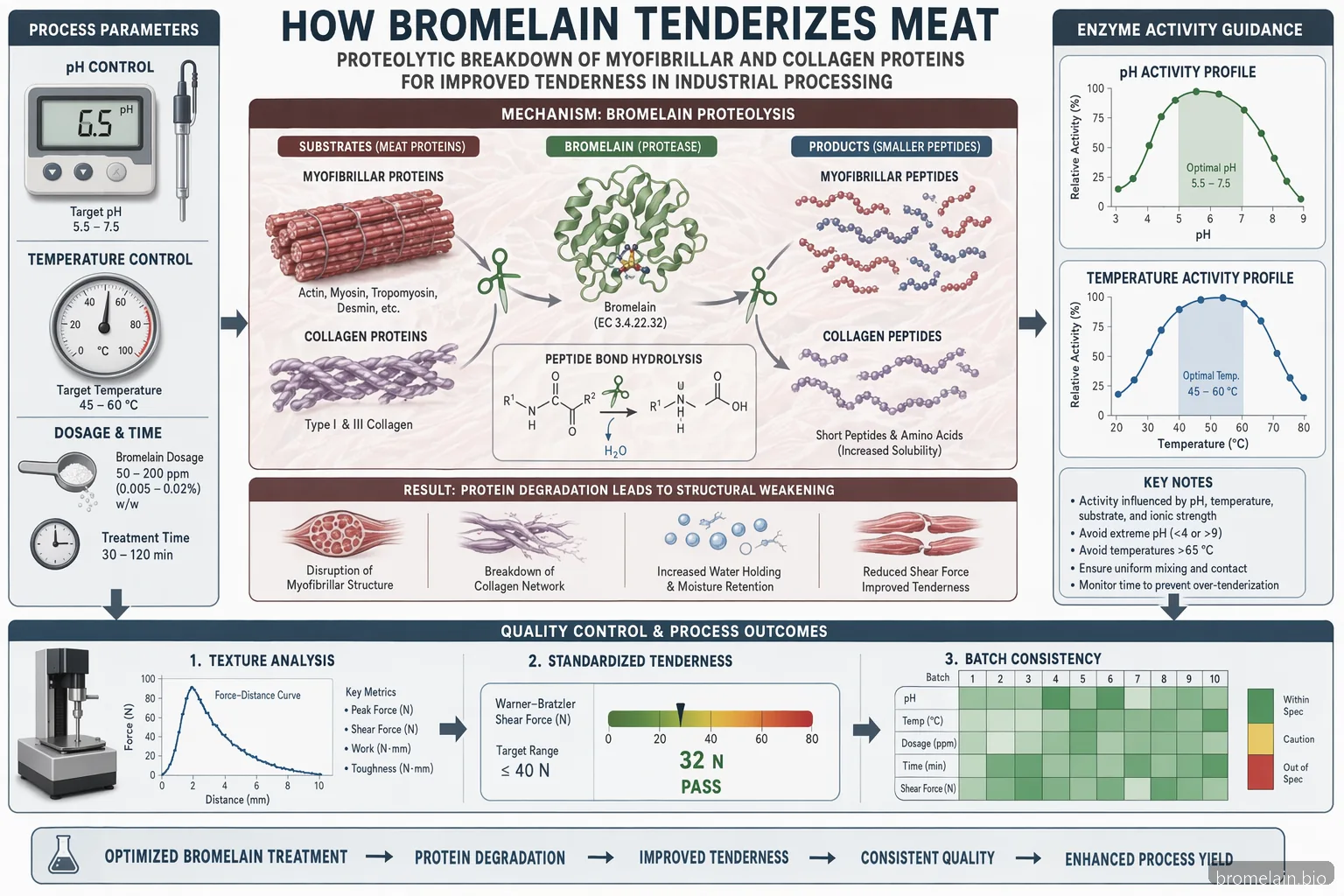
Practical bromelain trials usually start with a conservative dosage band and expand only after sensory, yield, and texture data are reviewed. As a general industrial starting point, many meat tenderization evaluations use low parts-per-million to low percentage inclusion levels depending on enzyme activity, product format, and contact time. Bromelain commonly shows useful activity in mildly acidic to neutral systems, often around pH 5.5 to 7.5, though the exact optimum depends on the product and supplier assay. Temperature also matters: activity increases with warmth but must be balanced against microbial control and product handling rules. Chilled marination may require longer contact time, while warm pre-treatment can accelerate proteolysis. Heat treatment can reduce enzyme activity, but validation is necessary because product geometry and thermal history vary. Processors should avoid copying a dosage from another product without confirming activity units, meat type, brine pickup, and finished texture targets.
Trial pH range: commonly evaluate pH 5.5-7.5 in meat systems • Trial temperature: validate under chilled, ambient, or controlled warm conditions • Dosage: base on declared activity units, not powder weight alone • Contact time: assess minutes to hours depending on product and process
How to Evaluate Bromelain Quality for Procurement
A bromelain supplier should be able to provide complete technical and quality documentation before commercial approval. At minimum, request a Certificate of Analysis for each lot, Technical Data Sheet, Safety Data Sheet, ingredient declaration, country of origin, storage conditions, shelf life, microbiological limits, heavy metal data where relevant, and the enzyme activity test method. Buyers should confirm whether the declared activity is comparable to their internal specification, because activity units can vary by assay. For meat tenderization, particle size, solubility, carrier composition, odor, color, and dispersion behavior can also affect plant handling. Lot-to-lot consistency is especially important when tenderization targets are narrow. If the product is marketed with names such as bromelain forte, clarify whether that refers to a higher activity grade, a blend, or simply a commercial descriptor. Procurement teams should avoid approving any enzyme without documentation that supports food use and traceability.
Request COA, TDS, SDS, activity method, and microbiological specification • Confirm carrier, solubility, and allergen or labeling implications • Compare lots using the same internal texture or protein breakdown test • Qualify backup supply only after equivalent pilot validation
Pilot Validation and QC Checks for Meat Plants
Pilot validation should reproduce the real plant process as closely as possible. A useful protocol defines the meat cut, initial pH, temperature, brine or marinade formula, injection or tumble parameters, enzyme addition point, hold time, cook schedule, and target finished texture. QC teams may use shear force, texture profile analysis, cook yield, purge, sliceability, sensory panel notes, and visual structure checks. Protein hydrolysis can also be monitored using internal analytical methods if available. Include a negative control without bromelain and at least two dosage levels around the expected commercial target. It is important to evaluate both under-tenderization and over-tenderization, because too much enzyme activity can create mushy texture, poor bite, or handling losses. Pilot data should be reviewed with production, R&D, QA, procurement, and the supplier’s technical team before plant-scale trials begin.
Use a control batch and multiple dosage levels • Measure shear force, yield, purge, sliceability, and sensory texture • Validate enzyme inactivation or reduction during cooking • Document acceptance limits before moving to commercial scale
Cost-in-Use and Supplier Qualification
For industrial enzyme purchasing, the lowest price per kilogram is rarely the best comparison. Bromelain cost-in-use depends on activity per gram, effective dosage, yield impact, rework reduction, texture consistency, handling losses, and whether technical support shortens validation time. A concentrated pineapple bromelain product may cost more per kilogram but require a lower inclusion rate if activity is higher and consistent. Supplier qualification should review documentation quality, lot traceability, lead time, packaging, storage stability, sample availability, responsiveness, and ability to support plant trials. Buyers should also confirm whether the supplier can provide routine COA data that match the commercial specification. For multi-site processors, harmonized specifications and cross-site pilot data help prevent performance drift. A qualified supplier should help the buyer define practical use conditions, not promise universal results across every meat system without validation.
Compare cost per finished kilogram, not only enzyme price • Include yield, waste, texture consistency, and validation support • Assess lead time, packaging integrity, and storage requirements • Maintain approved specifications and change-control expectations
Technical Buying Checklist
Buyer Questions
Bromelain is a pineapple-derived protease enzyme system used to break down selected meat proteins under controlled conditions. In meat tenderization, it helps modify texture and bite when dosage, pH, temperature, and contact time are validated. For industrial buyers, bromelain nedir is best answered as a functional processing enzyme, not a supplement claim or medical ingredient.
The onset of bromelain activity depends on enzyme strength, meat type, pH, temperature, salt level, and contact time. In chilled marinades, measurable effects may require longer holding, while warmer controlled conditions can accelerate proteolysis. Because bromelain wirkungseintritt is process-specific, buyers should run pilot trials with texture measurements rather than rely on a fixed universal time.
In this B2B context, bromelain wirkung or wirkung von bromelain refers to the enzyme’s functional effect on meat proteins: improved tenderness, modified bite, and potentially better consistency when controlled correctly. It does not refer to health effects or supplement outcomes. The useful effect should be confirmed by shear force, sensory evaluation, yield, purge, and finished product handling tests.
For food manufacturing, bromelain yan etkileri should be considered as processing risks rather than consumer medical advice. Potential issues include over-tenderization, mushy texture, inconsistent bite, formulation interactions, dust exposure during handling, and labeling or allergen review needs. Plants should follow the SDS, use appropriate worker controls, validate dosage, and confirm regulatory suitability for the intended market.
Terms such as bromelain forte are not enough for procurement approval. Ask the supplier to define the activity units, assay method, carrier system, solubility, recommended storage, and lot specification. A higher-activity grade may reduce dosage, but only if it disperses well and delivers the desired texture in your meat system. Compare grades by cost-in-use and pilot results.
Request a Free Sample and Quote
Tell us about your application and volume. We will send a free sample, COA, and competitive pricing within 24 hours.
Frequently Asked Questions
What is bromelain, or bromelain nedir, in industrial meat processing?
Bromelain is a pineapple-derived protease enzyme system used to break down selected meat proteins under controlled conditions. In meat tenderization, it helps modify texture and bite when dosage, pH, temperature, and contact time are validated. For industrial buyers, bromelain nedir is best answered as a functional processing enzyme, not a supplement claim or medical ingredient.
How quickly does bromelain work, or what is bromelain wirkungseintritt in meat?
The onset of bromelain activity depends on enzyme strength, meat type, pH, temperature, salt level, and contact time. In chilled marinades, measurable effects may require longer holding, while warmer controlled conditions can accelerate proteolysis. Because bromelain wirkungseintritt is process-specific, buyers should run pilot trials with texture measurements rather than rely on a fixed universal time.
What does bromelain wirkung mean for a meat processor?
In this B2B context, bromelain wirkung or wirkung von bromelain refers to the enzyme’s functional effect on meat proteins: improved tenderness, modified bite, and potentially better consistency when controlled correctly. It does not refer to health effects or supplement outcomes. The useful effect should be confirmed by shear force, sensory evaluation, yield, purge, and finished product handling tests.
Are there bromelain yan etkileri for food manufacturing applications?
For food manufacturing, bromelain yan etkileri should be considered as processing risks rather than consumer medical advice. Potential issues include over-tenderization, mushy texture, inconsistent bite, formulation interactions, dust exposure during handling, and labeling or allergen review needs. Plants should follow the SDS, use appropriate worker controls, validate dosage, and confirm regulatory suitability for the intended market.
How should we compare bromelain forte or high-activity bromelain grades?
Terms such as bromelain forte are not enough for procurement approval. Ask the supplier to define the activity units, assay method, carrier system, solubility, recommended storage, and lot specification. A higher-activity grade may reduce dosage, but only if it disperses well and delivers the desired texture in your meat system. Compare grades by cost-in-use and pilot results.
Related: Bromelain Enzyme for Meat Tenderization
Turn This Guide Into a Supplier Brief Request COA, TDS, SDS, samples, and pilot support to qualify bromelain for your meat tenderization process. See our application page for Bromelain Enzyme for Meat Tenderization at /applications/bromelain-meat-tenderization/ for specs, MOQ, and a free 50 g sample.
Contact