How Long Does It Take for Bromelain to Work in Meat Tenderization?
Industrial guide to bromelain tenderization time, dosage, pH, temperature, QC checks, COA/TDS/SDS review, pilot trials, and cost-in-use.
For processors buying bromelain enzyme, tenderization speed depends less on the name of the ingredient and more on activity units, dose, pH, temperature, contact time, and process control.
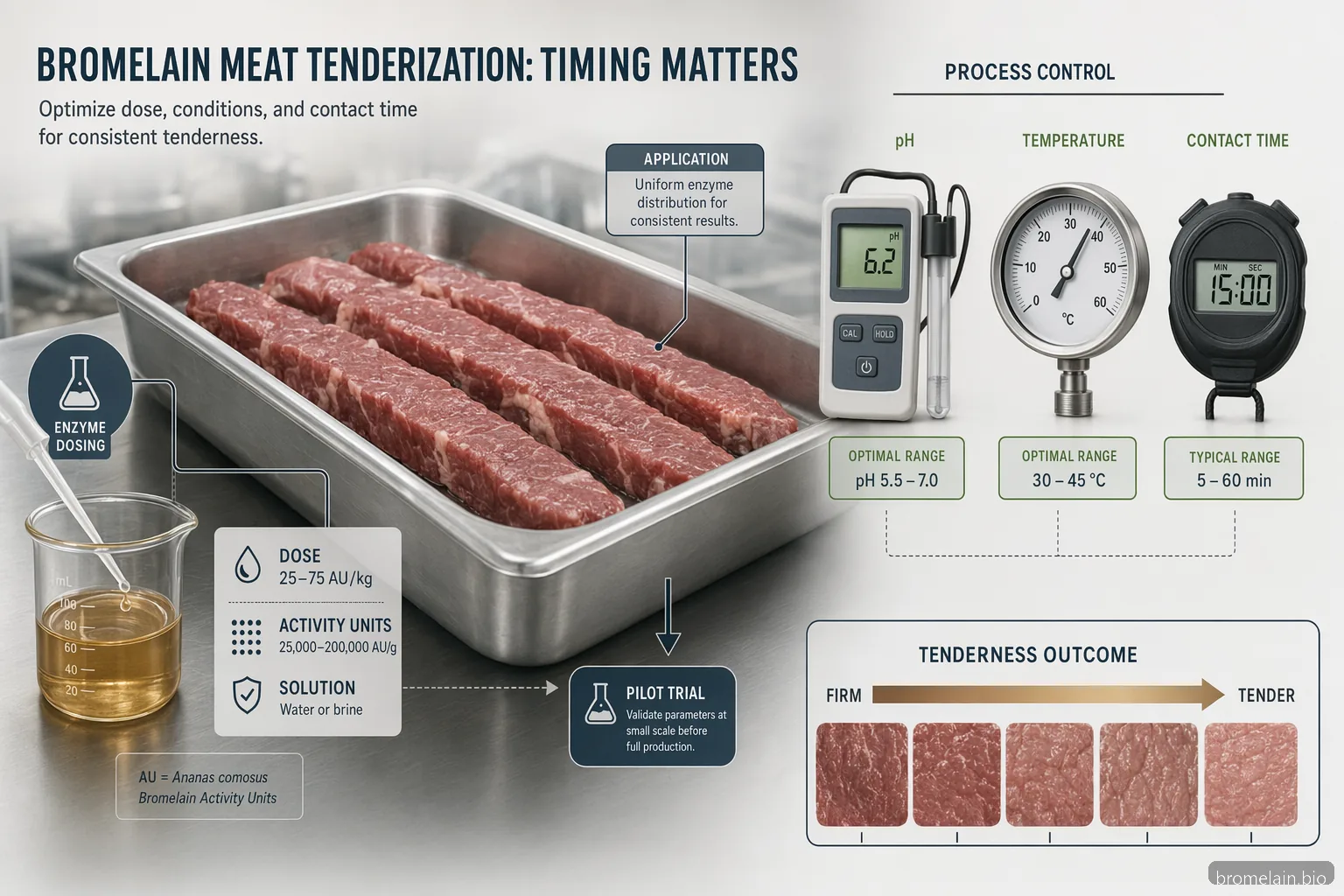
The practical answer: minutes to hours, depending on process design
In industrial meat tenderization, the answer to “how long does it take for bromelain to work” is usually 10–60 minutes in warm, controlled systems and 4–24 hours in chilled marinades. Bromelain is a proteolytic pineapple enzyme that hydrolyzes muscle proteins, so reaction rate is governed by enzyme activity, meat particle size, temperature, pH, salt level, and distribution. Thin cuts, injected products, tumbling, and comminuted meat respond faster because the enzyme contacts more surface area. Whole-muscle cuts, low temperatures, and uneven marinade uptake slow the effect. For B2B buyers, the key is not a universal time claim but a validated processing window that meets tenderness targets without excessive softening. Treat “what is bromelain,” “bromelain wirkung,” and “wirkung von bromelain” searches as starting points, then convert them into measurable specifications for your line.
Warm contact: often 10–60 minutes • Chilled marinade: often 4–24 hours • Faster action with injection, tumbling, or smaller pieces
Dosage bands for pilot trials
Bromelain dosage should be specified by enzyme activity and addition rate, not only by powder weight. Commercial products may be labeled in GDU/g, MCU/g, FCC PU/mg, or supplier-specific assay units, so direct comparisons require the TDS and COA. A practical first screen is 0.01–0.10% enzyme preparation by meat weight, or roughly 100–1,000 ppm product, then refine based on the declared activity and application. Lower levels may suit long chilled marinades, while higher levels may be needed for short warm contact or tougher raw material. Avoid copying supplement language such as bromelain supplement, bromelain forte, or bromelain nedir into procurement specifications; food-processing performance is batch, matrix, and process dependent. Run a dose ladder with at least three concentrations and one no-enzyme control.
Screen low, medium, and high dose levels • Normalize comparisons by activity units • Include a no-enzyme control for texture baseline
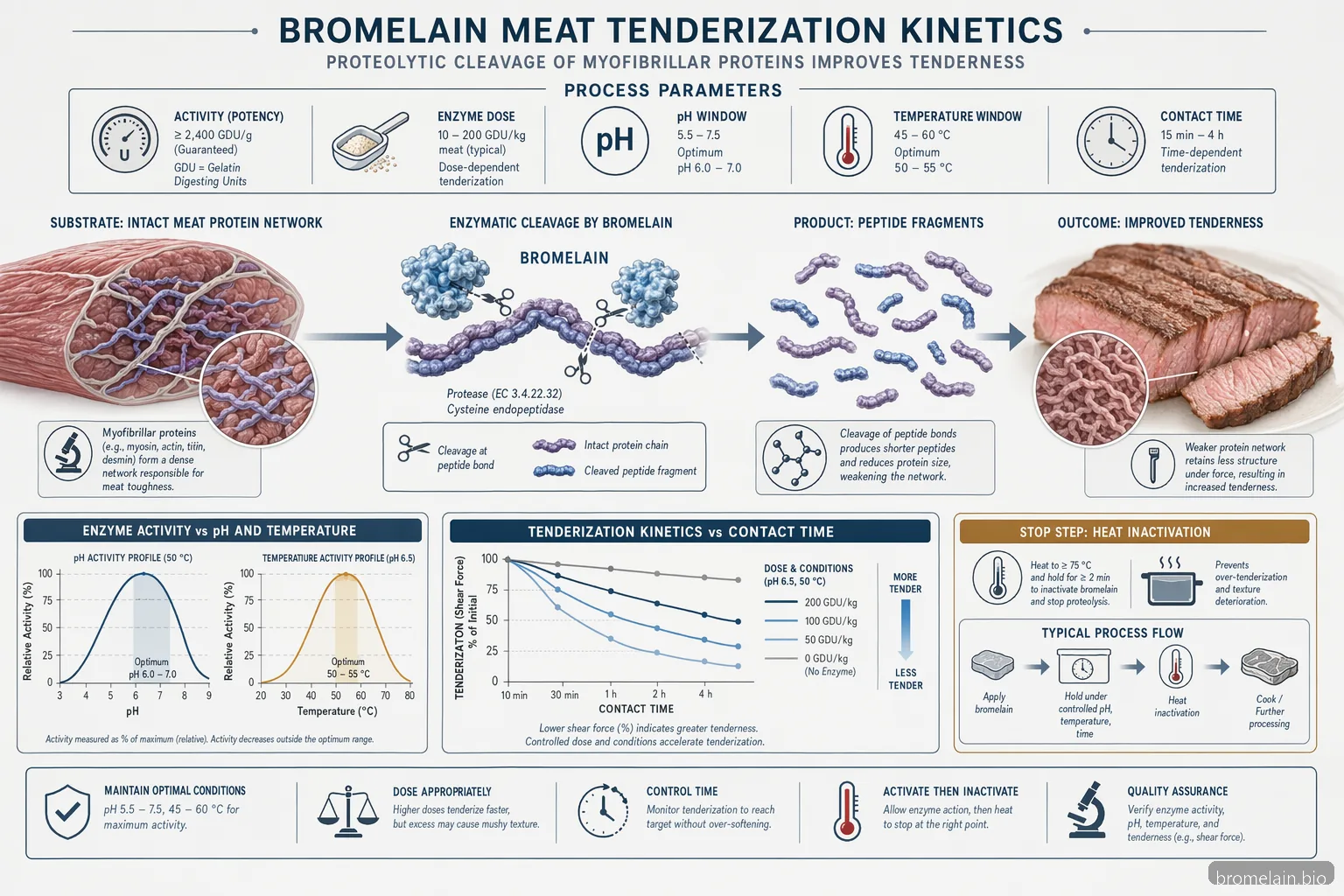
pH, temperature, and bromelain wirkungseintritt
The German search phrase “bromelain wirkungseintritt” roughly asks when the effect starts. In a plant, the onset is fastest when pH and temperature are near the enzyme’s useful operating zone. Bromelain is commonly trialed around pH 5.0–7.0 for meat systems, with many processors screening pH 5.5–6.5 first because it aligns with typical meat and marinade conditions. Temperature is a powerful lever: warm processing at 45–60°C can accelerate proteolysis, while 0–4°C storage slows activity but may still permit gradual tenderization over time. Excessive heat can denature the enzyme, which is useful when you need to stop the reaction during cooking or blanching. Validate hold time, come-up time, and inactivation steps using actual plant equipment, not only benchtop beakers.
Typical trial pH: 5.0–7.0 • Fast warm range: about 45–60°C • Chilled systems require longer contact time • Cooking can help stop further enzyme action
Troubleshooting inconsistent tenderization
If bromelain gives variable results, investigate distribution before changing suppliers. Uneven injection, poor tumble vacuum, incomplete powder hydration, localized high enzyme concentration, or brine stratification can create both tough and mushy zones in the same batch. Salt, phosphates, sugars, acids, and smoke components may alter water binding, pH, and diffusion, which changes the apparent enzyme effect. Raw material variation also matters: connective tissue, age, cut geometry, freeze-thaw history, and fat level can shift tenderness response. QC should include marinade pickup, pH before and after treatment, temperature logging, contact time, cook yield, purge, shear force or texture profile analysis, and trained sensory review. For “bromelain yan etkileri” in an industrial context, focus on worker handling, dust exposure, labeling, and SDS controls rather than consumer supplement side effects.
Check mixing and injection uniformity first • Track pH, temperature, and contact time by lot • Use texture and yield data, not only sensory notes
Supplier qualification and cost-in-use
A suitable bromelain supplier should support procurement, R&D, QA, and production teams with consistent documentation and responsive technical service. Request a current COA for each lot, a TDS with activity assay method, recommended storage, carrier information, solubility guidance, and usage constraints, plus an SDS for safe handling. Ask how activity is standardized, what lot-to-lot variation is typical, and whether the product is intended for food processing. Cost-in-use should calculate enzyme activity delivered per metric ton of meat, yield impact, rework reduction, processing time, and scrap risk, not just price per kilogram. Before approval, run pilot validation under your pH, temperature, equipment, and hold-time conditions, then confirm at production scale with predefined acceptance limits for texture, yield, purge, and flavor.
Review COA, TDS, and SDS before trials • Compare activity-adjusted cost, not only unit price • Validate at pilot and production scale
Technical Buying Checklist
Buyer Questions
In controlled warm processing, bromelain may produce measurable tenderization in 10–60 minutes. In chilled marinades, the useful window is often several hours to overnight. The exact time depends on enzyme activity, dose, pH, temperature, cut thickness, injection or tumbling efficiency, salt level, and raw material. Confirm timing with pilot trials and objective texture measurements before scaling up.
Bromelain is a protease enzyme system derived from pineapple material and used to hydrolyze proteins. In meat processing, that means it can reduce toughness when properly dosed and controlled. For industrial buying, the important details are declared activity, assay method, carrier, solubility, microbiological limits, storage stability, and application support, not consumer supplement positioning.
Yes. Overdosing, excessive contact time, warm holding without a kill step, or uneven distribution can create pasty or mushy texture. This is why processors should run dose ladders and define stop points through cooking or validated heat treatment. Monitor shear force, purge, yield, and sensory texture so the specification protects both tenderness and bite.
At minimum, request a COA for the lot, a TDS describing activity units and recommended use, and an SDS for safe handling. Depending on your quality system, you may also need ingredient composition, allergen statements where applicable, storage conditions, shelf-life guidance, country of origin, and microbiological specifications. Do not approve a supplier on price alone.
Compare activity delivered into the meat system, not only price per kilogram. Review the assay method, activity units, carrier content, solubility, lot variation, documentation quality, and technical support. Then run both products in the same pilot protocol at matched activity levels. The better offer is the one that meets texture, yield, flavor, handling, and cost-in-use targets.
Request a Free Sample and Quote
Tell us about your application and volume. We will send a free sample, COA, and competitive pricing within 24 hours.
Frequently Asked Questions
How long does it take for bromelain to work in a meat plant?
In controlled warm processing, bromelain may produce measurable tenderization in 10–60 minutes. In chilled marinades, the useful window is often several hours to overnight. The exact time depends on enzyme activity, dose, pH, temperature, cut thickness, injection or tumbling efficiency, salt level, and raw material. Confirm timing with pilot trials and objective texture measurements before scaling up.
What is bromelain in food-processing terms?
Bromelain is a protease enzyme system derived from pineapple material and used to hydrolyze proteins. In meat processing, that means it can reduce toughness when properly dosed and controlled. For industrial buying, the important details are declared activity, assay method, carrier, solubility, microbiological limits, storage stability, and application support, not consumer supplement positioning.
Can too much bromelain make meat mushy?
Yes. Overdosing, excessive contact time, warm holding without a kill step, or uneven distribution can create pasty or mushy texture. This is why processors should run dose ladders and define stop points through cooking or validated heat treatment. Monitor shear force, purge, yield, and sensory texture so the specification protects both tenderness and bite.
Which documents should a bromelain supplier provide?
At minimum, request a COA for the lot, a TDS describing activity units and recommended use, and an SDS for safe handling. Depending on your quality system, you may also need ingredient composition, allergen statements where applicable, storage conditions, shelf-life guidance, country of origin, and microbiological specifications. Do not approve a supplier on price alone.
How should we compare two bromelain enzyme offers?
Compare activity delivered into the meat system, not only price per kilogram. Review the assay method, activity units, carrier content, solubility, lot variation, documentation quality, and technical support. Then run both products in the same pilot protocol at matched activity levels. The better offer is the one that meets texture, yield, flavor, handling, and cost-in-use targets.
Related: Bromelain Enzyme for Meat Tenderization
Turn This Guide Into a Supplier Brief Request a bromelain technical consultation, COA/TDS/SDS review, and pilot-trial dosage plan for your meat tenderization process. See our application page for Bromelain Enzyme for Meat Tenderization at /applications/bromelain-meat-tenderization/ for specs, MOQ, and a free 50 g sample.
Contact